

Why Canã¢â‚¬â„¢t The Fed Control The Money Supply Perfectly?
Skip to headerSkip to primary contentSkip to footer
Does the Federal Reserve actually control the money supply?
The Fed has been pushing trillions of dollars into the financial system. But the money supply has barely grown.
The Federal Reserve, which bug the United States' monetary base (bank notes, coins, and banking concern reserves), has vastly increased its size since 2008 through quantitative easing programs — buying assets including Treasury bonds and mortgage-backed securities in open marketplace operations with newly-created money:

With such soaring quantities of new money resulting from quantitative easing, many economists including John Williams, Peter Schiff, and Marc Faber take predicted imminent high or hyper inflation. But by the broadest measures, similar MIT's Billion Prices Project, the predictions haven't played out. Inflation hasn't soared along with the budgetary base of operations.
And the money supply, which is different from the budgetary base of operations (the actual currency), hasn't really grown either. Bank notes and coins are the most tangible kind of dollars, simply there are many more than kinds of things called "dollars" that are used for exchange. Near obviously, credit. Banks create coin through the partial reserve cyberbanking system. Banks can lend — and thus create credit — upward to 10 times their reserves on hand.
This ways that while the monetary base of operations has tripled, the M2 money stock — which includes both checking and savings accounts every bit well as traveler'due south checks, fourth dimension deposits, and money market place deposit accounts — has not increased about as much:
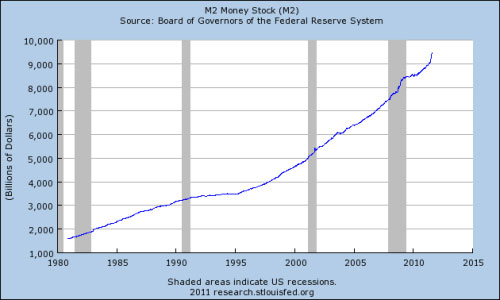
But even M2 does non encompass the entirety of the coin supply. There exists another banking arrangement — the shadow banking system— where credit expansion also takes place. Shadow credit creation takes place via securitization, a process by which debt-based assets similar mortgages, credit card debt, and car debt are pooled together and sold, and via repo, through which avails are pawned to a lender as collateral for credit.
Ane of the stories behind the 2008 crisis was the huge outgrowth of shadow credit creation that preceded it. However when the crisis hit, credit markets became spooked, shadow credit cosmos dried up, and the level of shadow avails began to deflate:

So the subconscious story behind the quantitative easing programs is that the new base coin that the Fed has pushed into the financial system has been replacing shadow credit that dried up subsequently 2008. The Fed does non control the coin supply — almost of the money supply has been created through credit. The Fed can only command ane small part of the money supply. This is shown in this chart of M4 — the total money supply, including shadow money — created by Professor Steve Hanke of the Cato Institute, with the monetary base issued past the Fed in olive:

Even after all that quantitative easing, the coin supply has still shrunk.
In fact, quantitative easing may be choking off shadow credit cosmos. As the Fed buys more than and more assets, in that location are less assets left in the market that tin can be used equally collateral for credit creation. This then-chosen "safe-asset shortage" is i factor that has driven the toll of Treasuries likewise as corporate bonds and even junk debt to record highs. If choking off shadow credit creation and replacing shadow money with traditional money was the Fed'southward implicit goal, then it is succeeding. But the money the Fed has issued since the crisis hasn't even fabricated upward for the shrinkage.
Recommended
The daily business briefing: April 27, 2022

The daily business briefing: Apr 27, 2022
Russian federation to cease sending gas to Poland and Bulgaria

Russian federation to terminate sending gas to Poland and Republic of bulgaria
Delta to begin paying flying attendants during boarding

Delta to begin paying flight attendants during boarding
Jack Dorsey praises Elon Musk after Twitter deal

Jack Dorsey praises Elon Musk subsequently Twitter bargain
Nigh Popular
The 'anti-woke' agenda is going to cost taxpayers big bucks
The 'anti-woke' agenda is going to cost taxpayers big bucks
Reports: Sweden and Finland hold to apply for NATO membership at the same fourth dimension

Reports: Sweden and Finland concur to apply for NATO membership at the same fourth dimension
5 cartoons almost maskless flying

5 cartoons virtually maskless flying
Skip to headerSkip to main contentSkip to footer
Source: https://theweek.com/articles/463787/does-federal-reserve-really-control-money-supply
Posted by: griffinthivalt1944.blogspot.com
0 Response to "Why Canã¢â‚¬â„¢t The Fed Control The Money Supply Perfectly?"
Post a Comment