

When In The Business Cycle Does The Federal Reserve Want To Increase The Money Supply?
9.3 The Federal Reserve Arrangement
Learning Objectives
- Explain the primary functions of central banks.
- Draw how the Federal Reserve System is structured and governed.
- Identify and explicate the tools of budgetary policy.
- Draw how the Fed creates and destroys money when it buys and sells federal government bonds.
The Federal Reserve Organisation of the United States, or Fed, is the U.South. primal depository financial institution. Japan's central bank is the Bank of Nihon; the European Union has established the European Cardinal Bank. Nearly countries take a central bank. A cardinal banking concern performs five chief functions: (1) it acts equally a banker to the central government, (ii) it acts as a broker to banks, (3) it acts as a regulator of banks, (iv) information technology conducts monetary policy, and (five) information technology supports the stability of the fiscal arrangement.
For the first 137 years of its history, the United States did not accept a truthful central bank. While a key bank was frequently proposed, there was resistance to creating an institution with such enormous power. A series of bank panics slowly increased support for the creation of a central bank. The bank panic of 1907 proved to be the last straw. Bank failures were so widespread, and depositor losses and then heavy, that concerns about centralization of power gave way to a desire for an institution that would provide a stabilizing force in the banking industry. Congress passed the Federal Reserve Act in 1913, creating the Fed and giving information technology all the powers of a central bank.
Construction of the Fed
In creating the Fed, Congress determined that a central bank should exist as independent of the regime every bit possible. It besides sought to avert likewise much centralization of ability in a unmarried establishment. These potentially contradictory goals of independence and decentralized power are axiomatic in the Fed'due south structure and in the continuing struggles betwixt Congress and the Fed over possible changes in that structure.
In an effort to decentralize power, Congress designed the Fed every bit a system of 12 regional banks, every bit shown in Effigy 9.eight "The 12 Federal Reserve Districts and the Cities Where Each Bank Is Located". Each of these banks operates as a kind of bankers' cooperative; the regional banks are endemic past the commercial banks in their districts that have chosen to be members of the Fed. The owners of each Federal Reserve bank select the board of directors of that banking concern; the lath selects the depository financial institution'due south president.
Figure 9.8 The 12 Federal Reserve Districts and the Cities Where Each Bank Is Located
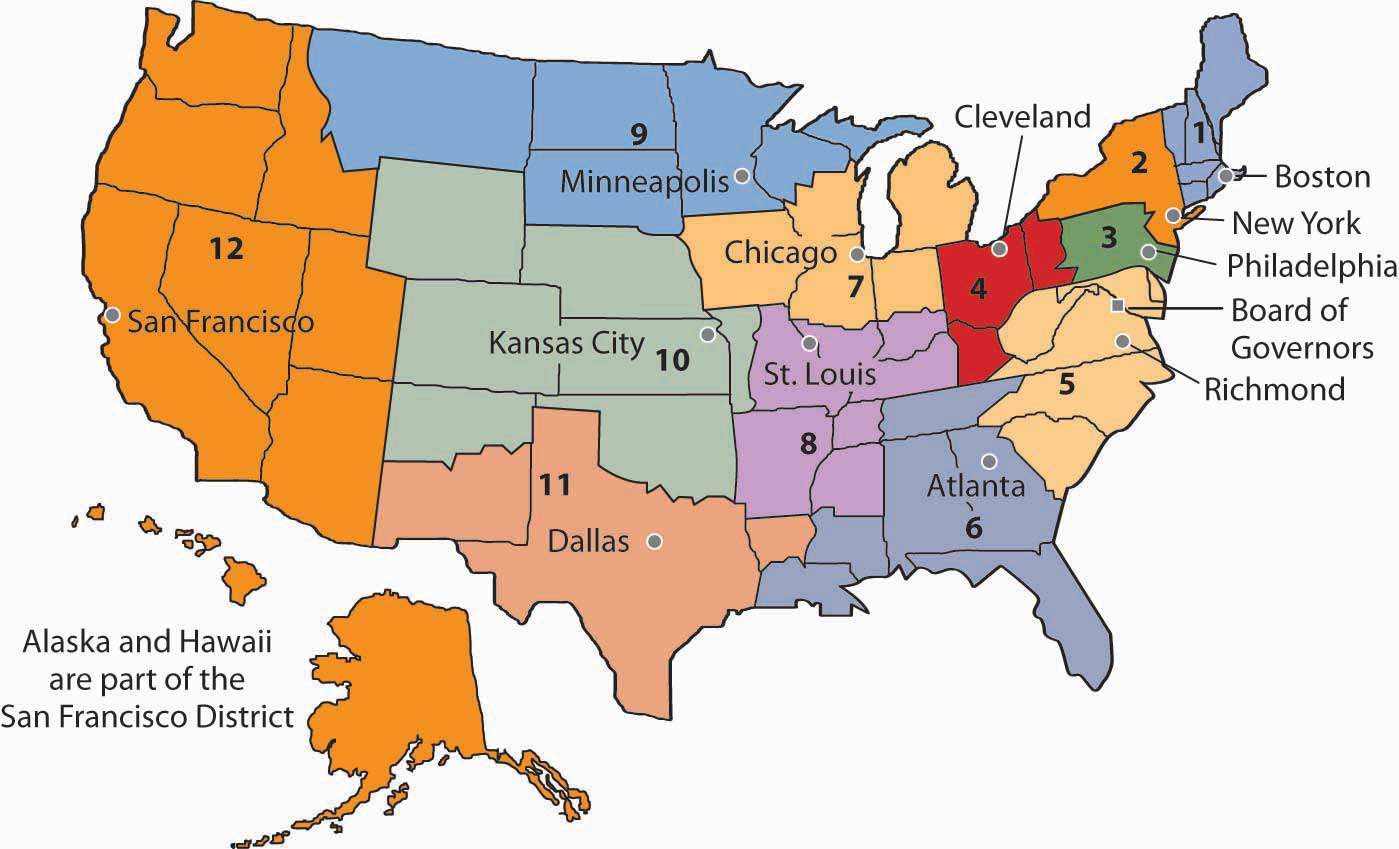
Several provisions of the Federal Reserve Human activity seek to maintain the Fed's independence. The board of directors for the entire Federal Reserve Organisation is called the Board of Governors. The seven members of the board are appointed by the president of the United States and confirmed by the Senate. To ensure a big measure out of independence from any ane president, the members of the Board of Governors have xiv-year terms. One member of the lath is selected past the president of the United states to serve every bit chairman for a iv-year term.
Equally a further means of ensuring the independence of the Fed, Congress authorized information technology to buy and sell federal government bonds. This activity is a profitable one that allows the Fed to pay its own bills. The Fed is thus non dependent on a Congress that might otherwise be tempted to strength a particular set of policies on it. The Fed is limited in the profits it is allowed to earn; its "excess" profits are returned to the Treasury.
It is important to recognize that the Fed is technically not part of the federal government. Members of the Board of Governors do non legally have to reply to Congress, the president, or anyone else. The president and members of Congress can certainly try to influence the Fed, but they cannot lodge it to practise annihilation. Congress, however, created the Fed. It could, past passing another police force, cancel the Fed'south independence. The Fed can maintain its independence only by keeping the support of Congress—and that sometimes requires being responsive to the wishes of Congress.
In recent years, Congress has sought to increase its oversight of the Fed. The chairman of the Federal Reserve Lath is required to written report to Congress twice each year on its monetary policy, the fix of policies that the fundamental bank tin can use to influence economic activity.
Powers of the Fed
The Fed's principal powers stem from its authority to carry monetary policy. It has three main policy tools: setting reserve requirements, operating the disbelieve window and other credit facilities, and conducting open-market place operations.
Reserve Requirements
The Fed sets the required ratio of reserves that banks must concur relative to their eolith liabilities. In theory, the Fed could use this power as an instrument of budgetary policy. It could lower reserve requirements when it wanted to increment the money supply and raise them when it wanted to reduce the coin supply. In practice, however, the Fed does not use its power to set reserve requirements in this manner. The reason is that frequent manipulation of reserve requirements would brand life difficult for bankers, who would have to arrange their lending policies to changing requirements.
The Fed'south power to set reserve requirements was expanded past the Budgetary Control Act of 1980. Before that, the Fed set reserve requirements only for commercial banks that were members of the Federal Reserve System. Nigh banks are not members of the Fed; the Fed'due south control of reserve requirements thus extended to but a minority of banks. The 1980 act required nigh all banks to satisfy the Fed'south reserve requirements.
The Disbelieve Window and Other Credit Facilities
A major responsibleness of the Fed is to act as a lender of last resort to banks. When banks fall short on reserves, they can borrow reserves from the Fed through its discount window. The discount charge per unit is the interest charge per unit charged past the Fed when it lends reserves to banks. The Lath of Governors sets the disbelieve charge per unit.
Lowering the discount rate makes funds cheaper to banks. A lower disbelieve rate could place down pressure on interest rates in the economy. All the same, when financial markets are operating normally, banks rarely infringe from the Fed, reserving use of the discount window for emergencies. A typical bank borrows from the Fed but nearly in one case or twice per year.
Instead of borrowing from the Fed when they need reserves, banks typically rely on the federal funds marketplace to obtain reserves. The federal funds market is a market in which banks lend reserves to one another. The federal funds rate is the interest rate charged for such loans; information technology is adamant by banks' demand for and supply of these reserves. The ability to set the discount rate is no longer an important tool of Federal Reserve policy.
To deal with the contempo financial and economical conditions, the Fed greatly expanded its lending beyond its traditional disbelieve window lending. Every bit falling house prices led to foreclosures, private investment banks and other financial institutions came nether increasing pressure. The Fed made credit available to a wide range of institutions in an effort to stem the crisis. In 2008, the Fed bailed out ii major housing finance firms that had been established by the government to prop up the housing industry—Fannie Mae (the Federal National Mortgage Association) and Freddie Mac (the Federal Dwelling house Mortgage Corporation). Together, the two institutions backed the mortgages of one-half of the nation'due south mortgage loans (Zuckerman, 2008). It also agreed to provide $85 billion to AIG, the huge insurance firm. AIG had a subsidiary that was heavily exposed to mortgage loan losses, and that bedridden the firm. The Fed adamant that AIG was simply besides big to be allowed to fail. Many banks had ties to the giant institution, and its failure would take been a accident to those banks. As the United States faced the worst fiscal crunch since the Keen Depression, the Fed took center phase. Whatever its office in the fiscal crisis of 2007–2008, the Fed remains an of import backstop for banks and other financial institutions needing liquidity. And for that, information technology uses the traditional discount window, supplemented with a wide range of other credit facilities. The Case in Point in this section discusses these new credit facilities.
Open-Market Operations
The Fed'due south ability to buy and sell federal authorities bonds has proved to be its well-nigh potent policy tool. A bond is a promise by the issuer of the bond (in this instance the federal government) to pay the owner of the bond a payment or a series of payments on a specific date or dates. The buying and selling of federal regime bonds by the Fed are called open-market operations. When the Fed buys or sells government bonds, it adds or subtracts reserves from the banking organization. Such changes bear upon the coin supply.
Suppose the Fed buys a authorities bond in the open up market. It writes a check on its own account to the seller of the bond. When the seller deposits the check at a banking concern, the bank submits the bank check to the Fed for payment. The Fed "pays" the check by crediting the banking concern's account at the Fed, so the banking concern has more reserves.
The Fed'south purchase of a bond can be illustrated using a balance canvas. Suppose the Fed buys a bail for $ane,000 from ane of Tiptop Banking company's customers. When that customer deposits the cheque at Acme, checkable deposits will ascent by $1,000. The bank check is written on the Federal Reserve System; the Fed will credit Acme's business relationship. Summit'southward reserves thus rise by $1,000. With a 10% reserve requirement, that volition create $900 in backlog reserves and set off the same procedure of money expansion as did the cash deposit we take already examined. The difference is that the Fed's buy of a bond created new reserves with the stroke of a pen, where the cash deposit created them past removing $1,000 from currency in circulation. The purchase of the $1,000 bond by the Fed could thus increase the coin supply past every bit much equally $10,000, the maximum expansion suggested by the deposit multiplier.
Figure 9.9
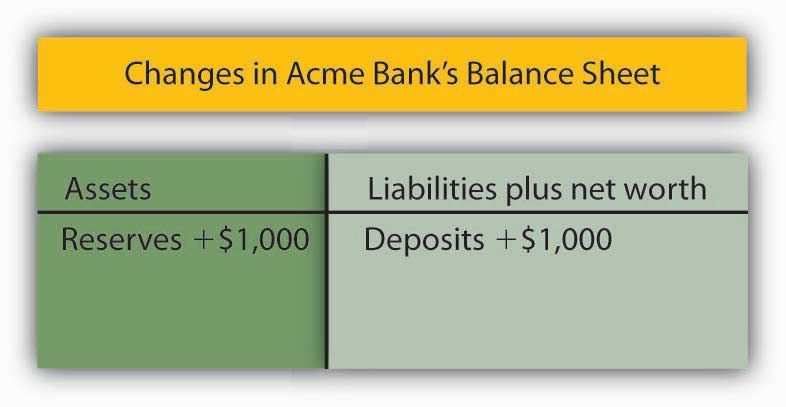
Where does the Fed go $1,000 to purchase the bail? Information technology just creates the coin when it writes the bank check to purchase the bond. On the Fed'due south rest sheet, assets increase past $1,000 because the Fed now has the bond; banking concern deposits with the Fed, which represent a liability to the Fed, rising by $one,000 also.
When the Fed sells a bond, information technology gives the buyer a federal government bond that it had previously purchased and accepts a cheque in commutation. The depository financial institution on which the check was written will find its deposit with the Fed reduced by the amount of the cheque. That bank'south reserves and checkable deposits will autumn by equal amounts; the reserves, in effect, disappear. The result is a reduction in the coin supply. The Fed thus increases the money supply by buying bonds; it reduces the money supply past selling them.
Figure ix.10 "The Fed and the Menstruum of Coin in the Economy" shows how the Fed influences the menstruation of coin in the economy. Funds flow from the public—individuals and firms—to banks as deposits. Banks utilise those funds to brand loans to the public—to individuals and firms. The Fed tin influence the book of depository financial institution lending past buying bonds and thus injecting reserves into the system. With new reserves, banks will increment their lending, which creates still more deposits and still more lending as the eolith multiplier goes to work. Alternatively, the Fed can sell bonds. When it does, reserves flow out of the organisation, reducing bank lending and reducing deposits.
Figure 9.x The Fed and the Flow of Money in the Economy
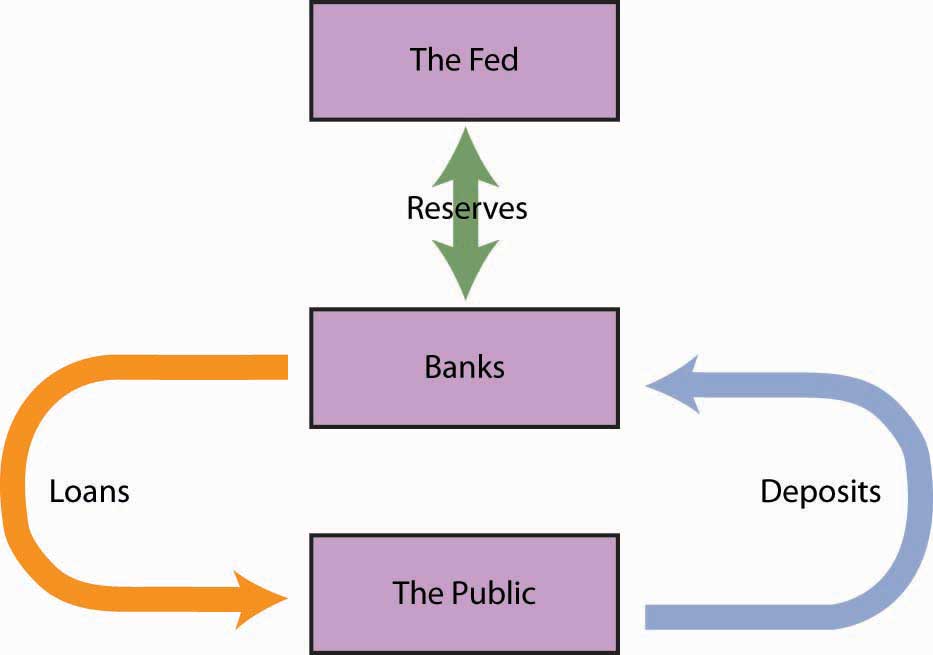
Individuals and firms (the public) make deposits in banks; banks make loans to individuals and firms. The Fed can purchase bonds to inject new reserves into the system, thus increasing bank lending, which creates new deposits, creating yet more lending as the deposit multiplier goes to piece of work. Alternatively, the Fed can sell bonds, withdrawing reserves from the system, thus reducing bank lending and reducing full deposits.
The Fed's purchase or auction of bonds is conducted by the Open Market Desk-bound at the Federal Reserve Bank of New York, ane of the 12 commune banks. Traders at the Open up Market Desk-bound are guided past policy directives issued by the Federal Open up Market Committee (FOMC). The FOMC consists of the vii members of the Board of Governors plus five regional bank presidents. The president of the New York Federal Reserve Depository financial institution serves as a member of the FOMC; the other 11 banking concern presidents take turns filling the remaining 4 seats.
The FOMC meets 8 times per year to chart the Fed'south monetary policies. In the past, FOMC meetings were closed, with no report of the committee'southward action until the release of the minutes 6 weeks after the meeting. Faced with pressure to open its proceedings, the Fed began in 1994 issuing a written report of the decisions of the FOMC immediately after each meeting.
In practice, the Fed sets targets for the federal funds rate. To achieve a lower federal funds rate, the Fed goes into the open up market buying securities and thus increasing the money supply. When the Fed raises its target rate for the federal funds rate, it sells securities and thus reduces the coin supply.
Traditionally, the Fed has bought and sold short-term authorities securities; yet, in dealing with the condition of the economy in 2009, wherein the Fed has already fix the target for the federal funds rate at near zero, the Fed has announced that it will likewise exist buying longer term government securities. In and so doing, information technology hopes to influence longer term interest rates, such as those related to mortgages.
Primal Takeaways
- The Fed, the central bank of the United States, acts as a depository financial institution for other banks and for the federal regime. It also regulates banks, sets monetary policy, and maintains the stability of the fiscal system.
- The Fed sets reserve requirements and the discount rate and conducts open-market operations. Of these tools of budgetary policy, open-market operations are the most important.
- Starting in 2007, the Fed began creating additional credit facilities to help stabilize the financial system.
- The Fed creates new reserves and new coin when information technology purchases bonds. Information technology destroys reserves and thus reduces the money supply when it sells bonds.
Try Information technology!
Suppose the Fed sells $eight million worth of bonds.
- How do bank reserves change?
- Will the money supply increase or subtract?
- What is the maximum possible change in the coin supply if the required reserve ratio is 0.ii?
Instance in Point: Fed Supports the Fiscal Organization past Creating New Credit Facilities
Well earlier most of the public became aware of the precarious state of the U.Due south. fiscal system, the Fed began to see signs of growing financial strains and to act on reducing them. In particular, the Fed saw that short-term interest rates that are often quite close to the federal funds rate began to rise markedly higher up it. The widening spread was alarming, because it suggested that lender conviction was failing, even for what are generally considered low-risk loans. Commercial paper, in which large companies borrow funds for a period of about a month to manage their cash flow, is an example. Even companies with high credit ratings were having to pay unusually high interest rate premiums in gild to go funding, or in some cases could not become funding at all.
To deal with the drying upward of credit markets, in belatedly 2007 the Fed began to create an alphabet soup of new credit facilities. Some of these were offered in conjunction with the Section of the Treasury, which had more latitude in terms of accepting some credit risk. The facilities differed in terms of collateral used, the duration of the loan, which institutions were eligible to infringe, and the toll to the borrower. For example, the Primary Dealer Credit Facility (PDCF) allowed primary dealers (i.e., those fiscal institutions that normally handle the Fed's open market operations) to obtain overnight loans. The Term Asset-Backed Securities Loan Facility (TALF) immune a broad range of companies to borrow, using the master dealers as conduits, based on qualified asset-backed securities related to student, car, credit card, and small business debt, for a three-year period. Most of these new facilities were designed to exist temporary. Starting in 2009 and 2010, the Fed began closing a number of them or at least preventing them from issuing new loans.
The common goal of all of these various credit facilities was to increase liquidity in lodge to stimulate private spending. For instance, these credit facilities encouraged banks to skin downwards their excess reserves (which grew enormously as the financial crisis unfolded and the economy deteriorated) and to make more than loans. In the words of Fed Chairman Ben Bernanke:
"Liquidity provision past the central bank reduces systemic take a chance by assuring marketplace participants that, should brusk-term investors brainstorm to lose confidence, financial institutions volition exist able to run into the resulting demands for greenbacks without resorting to potentially destabilizing fire sales of assets. Moreover, backstopping the liquidity needs of financial institutions reduces funding stresses and, all else equal, should increase the willingness of those institutions to lend and make markets."
The legal dominance for most of these new credit facilities came from a particular section of the Federal Reserve Act that allows the Board of Governors "in unusual and exigent circumstances" to extend credit to a wide range of market players.
Sources: Ben Southward. Bernanke, "The Crisis and the Policy Response" (Stemp Lecture, London School of Economics, London, England, January 13, 2009); Richard DiCecio and Charles South. Gascon, "New Monetary Policy Tools?" Federal Reserve Bank of St. Louis Budgetary Trends, May 2008; Federal Reserve Board of Governors Spider web site at http://www.federalreserve.gov/monetarypolicy/default.htm.
Answer to Try Information technology! Trouble
- Bank reserves fall past $viii meg.
- The coin supply decreases.
- The maximum possible decrease is $twoscore million, since ∆D = (1/0.2) × (−$8 one thousand thousand) = −$40 million.
References
Zuckerman, South., "Feds Take Control of Fannie Mae, Freddie Mac," The San Francisco Chronicle, September eight, 2008, p. A-1.
Source: https://open.lib.umn.edu/macroeconomics/chapter/9-3-the-federal-reserve-system/
Posted by: griffinthivalt1944.blogspot.com
0 Response to "When In The Business Cycle Does The Federal Reserve Want To Increase The Money Supply?"
Post a Comment